Showing posts with label Argentina. Show all posts

Friday, 17 July 2015

How to pass 7 hours in an airport

Essential items in the fight against airport boredom

There are a number of reasons why you might end up spending seven (or another number) of hours in an airport. It could be that your flight is delayed, or like us, your flights were so cheap that you have to change a few times on your way home.

In our instance, the seven hours were at Brazil's Sao Paolo Airport and the prospect of heading into such a vast city just to try and get back within the time frame was too much to contemplate. So we decided to pass them in the terminal building, and actually, they went pretty quickly.

Our entertainment system

When I was growing up and we travelled a lot as a family, my dad always carried with him an old tobacco tin of his grandfather's, which contained all the necessary items required to keep a small group of people entertained when travelling. They fitted in perfectly, with two pencil sharpeners to fill a gap. I remember the intent look on a boy's face as my dad sharpened a pencil for him with one of these items on a trip to Malawi.

Knowing that we would have such a long time to wait I decided to create my own version of this tin before leaving home. I packed a set of cards, six dice and instead of the pencil sharpeners, two rubber pigs. Along with these materials, I also had to hand the instructions for a number of games to play with them (thanks to Pops for providing these). It's amazing how two small pigs can keep two grown women entertained for such a long time. Any travellers who have not encountered Pass the Pigs should look into this quirky and easily transportable game.

     
Dice games in Sao Paulo Airport

The dice also got used, with classics Yahtzee and Farkle going down well. For anyone not familiar with these games, it is worth learning the rules and packing a set of dice on your next trip. You never know when you might get stuck at an airport or find yourself with only a few Uruguayan pesos left on a wet evening in Colonia.

People watching

Airports are fascinating places, with plenty of people milling around and trying to achieve various outcomes. After spending 11 days in several countries on our trip, we enjoyed working out where the different people were from. There were far fewer mate cups and flasks, as we were no longer in Argentina or Uruguay, but the thick soles of some of the women were a give-away that were from one of these countries, as we had spotted them throughout our trip.

Eating

Seven hours is a long time to go without food, but this can be further complicated by not having any money to purchase anything. This can be particularly tricky if you are in an airport in a country different to the one you have been visiting. We had been in Brazil for half a day on this trip, but had spent all of our reales at Iguazu, so needed to find an alternative source.

One solution was to exchange some of the Argentinian pesos we had left, but the cambio at the airport wanting to charge $17 to do this, making it not worth it at all. Despite the fact there were ATMs displaying the names of our banks on them, our debit cards did not grant us access to any cash. In the end we chanced it and ordered some food and found we could pay by card. If this hadn't worked, we were going to be a bit stuck and undoubtedly, hungry.

Other ideas

There are plenty of other things that you can do to help pass the time at an airport, including:
  • Reading
  • Catching up on your travel journal
  • Shopping
  • Checking into an airport lounge
  • Getting a massage
  • Having your nails done
  • Writing your postcards and desperately trying to find a post box

Game rules - courtesy of Pops

Farkle
  • A game using SIX dice for any number of players.
  • The aim is to reach a target score (say 5,000 points).
  • The key to the game is to decide when to bank your score, as if you do not score you lose all your score for that turn.
  • What gives you a score? – 1 is 100 5 is 50
  • Three 2s = 200, three 3s = 300, three 4s = 400, three 5s = 500, three 6s = 600, BUT three 1s = 1,000 AND 1, 2, 3, 4, 5, 6 = 2,000. All these scores have to be thrown with one throw of the dice.
  • Throw all the dice, but you must keep at least one scoring dice (a1, a 5 or 3 of a kind, etc). Keep a mental record of your score, throw the remaining dice (if you wish) and add on the score from this new dice. You must score with each throw or you will forfeit all your points for that round. If you use all six dice, you can throw again and add on to this mental score, but there is always the chance you could lose all your points accrued in that turn if you fail to score. When you decide to stick that score is then written down and used to head for the target score.
  • You can pass any unused dice to the next person – if they choose to use those dice then your score from that round becomes theirs. E.g. if the dice were passed to you and the person passing had just scored 350 and you rolled the dice and rolled a 1 you would then have a score of 450. You do not have to accept the unused dice and may simply start again with all six dice.

Yahtzee
  • A game using FIVE dice for any number of players.
  • The aim, to obtain the highest score of all the players.
  • There are 13 rounds of play and 13 ways to use the dice for one of the ways of scoring – but you may decide to forfeit one of the ways of scoring if you cannot fulfil a way of scoring.
  • With each throw, you first throw all 5 dice. You may keep some or all of these dice and throw the remaining dice twice more. You then have to decide which of the 13 rounds you are going to score against. 
  • With the top half of the scoring sheet (i.e. 3 x 1; 3 x 2; 3 x 3; 3 x 4; 3 x 5; 3 x 6) if you exceed or reach the target score of 63 you get an additional bonus of 35.
  • What each term means:
  • Yahtzee: 5 of the same number
  • Full house: 3 of 1 number and 2 of a different number 
  • Low straight: 4 numbers in order e.g. 2, 3, 4, 5,
  • High straight: 5 numbers in a row e.g. 1, 2, 3, 4, 5, 
  • Low score and high score: Throw as above, the only stipulation that the low score must be less than the high score

Thursday, 18 June 2015

A walk along Defensa during the Feria de San Telmo


There is nothing quite like strolling along San Telmo's main street, Defensa, on a Sunday morning when hundreds of stalls have been set up selling everything from antiques to mate flasks and alpaca finger puppets. In fact, this is one of the most quintessential experiences to be had in Buenos Aires and one that I will never tire of having.


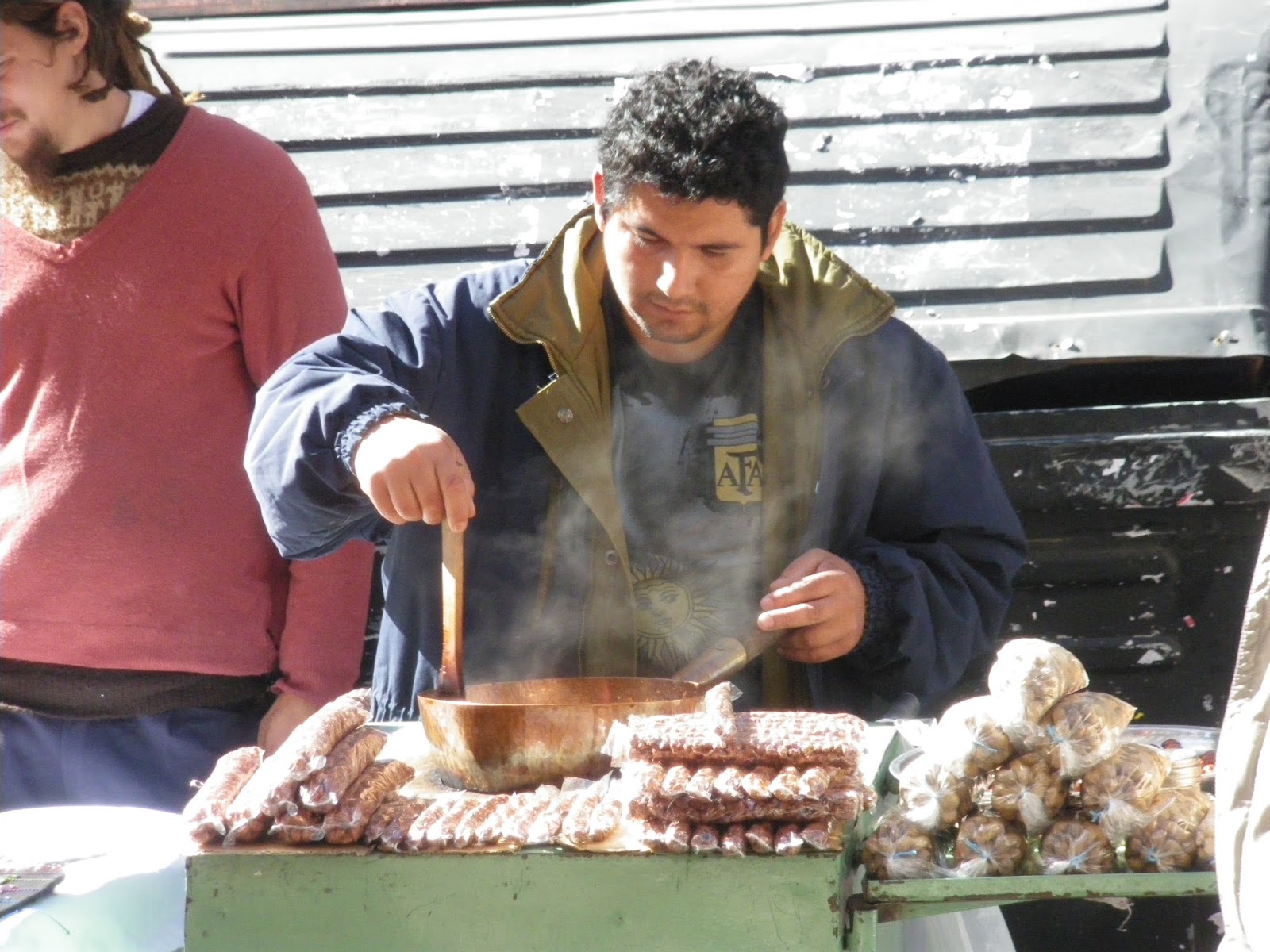
The smell of these delicious nuts fills the air
and adds to the general atmosphere of the feria.


Anyone for mate? A taste for this herb-based drink
is somewhat necessary in Argentina, as it is fairly
ubiquitous, with everyone carrying around their kit
and places to refill hot water at regular intervals.


These traditional soda siphons are the real deal.
You can tell a true antique down to their colours,
as only clear, blue, green and turquoise
were originally produced.


A fantastic assortment of
odds and ends on sale.


Gardel lives indeed.
The famous tango singer is regularly
emulated on the streets of San Telmo.


This incredible lady could be found at
the quieter end of Defensa, making a
lot of commotion of her own. She was
very cheerful and playing a setup made
from all manner of household objects.
She even threw her drumsticks in the
air every now and then. She also had
a little trumpet fashioned out of plastic
bottles.

Monday, 18 May 2015

Travelling in your early 20s versus travelling in your late 20s

Then                                                              Now

Returning to Argentina six years after my original trip has given me a great opportunity to compare the differences between travelling in my early 20s and again in my late 20s. Some of the changes are due to circumstances, while others concern my preferences. Either way, it is quite interesting to take a look at what has changed.

Less time

With a steady job I don't have the ability to just take off for three months like I did in 2009. Instead, I had two weeks annual leave, including travel time, which meant limiting myself to a small section of northern Argentina, Iguazu and Uruguay. Six years ago I went all the way down to Ushuaia and weaved my way back up between Argentina and Chile.

This was a very different kind of trip, but my travel companion Tania and I were pleased with the route we decided to take. This was essentially a loop, starting and ending in Buenos Aires, but taking in some key sites along the way. Iguazu was as amazing as I remembered and the Uruguayan cities of Montevideo and Colonia del Sacramento offered a relaxed contrast to the freneticism of Buenos Aires.

Notes at an antiques market in Montevideo

More money

The aforementioned job means I have a little bit more cash to spend than the bare basics I could justify back then. In my early 20s I just wanted to get away, even if I couldn't really afford it. As I draw closer to the big 3-0, however, I find myself requiring a few extra creature comforts. They came in a number of forms.

Cama instead of semi cama

Argentina is a vast country and the need for overnight bus journeys is inevitable. Back in 2009 I would only ever pay for semi cama seats, whereas this time I was more inclined to go for the whole cama experience and lie back flat. With only 11 nights in South America and three of these used to cover some lengthy distances, a cama seat offered a better opportunity to get some sleep and make the most of the time available.

Our palace accommodation in San Telmo

Airbnb over Couchsurfing

I have really loved my Couchsurfing experiences and believe that Airbnb is a relative of the movement. It means a little bit more comfort and guarantee, but with the same ethos. A more grown-up version for a more grown-up me. This trip was my first one with Airbnb and it went well. We especially enjoyed staying in a palace in the San Telmo district of Buenos Aires.

Digital over SLR

It pains me to say it, but a digital camera is more convenient than my faithful Olympus SLR that I have dragged on many of my trips. I am still in love with my old manual camera, but it is not best suited for blog posts and tweets, which meant I left it at home. I'm sure my previous travel companions would agree that digital photography is quicker, but I still love the romance of travelling with my SLR and listening to the satisfying 'clunk' it makes when taking pictures. One day I will adventure with it again.

Wednesday, 1 April 2015

Back to where it all began: Returning to Argentina

Iguazu Falls - 2009

Back when I first started this blog I was about to head off to Argentina and am currently preparing to return. In those early days my blog was pretty basic and I did a few posts during my original stint in South America. There was very little formatting, linking or trickery involved.

Some six years later a lot has changed, with both me and my blog. For a start I have undergone journalism training and am now employed as a travel writer (23-year-old me is very happy about this). I like to think that my writing style has evolved and my blog has come a long way.

Over the years that I have had this blog, it has been a space where I can try out new things and put what I've learned through studying online journalism and working in the industry into practice. It is still not as shiny and professional as I would like, but as I learn, I like to think it improves.

While the blog has come a long way since those original posts, the reasons for writing it remain the same. My passion for travel has never dwindled and my desire to write stays with me. Who knows where it might lead in another six years? Perhaps I'll be planning my third trip to Argentina, but I hope I'm still travelling and writing, and loving it as much as I do now.

On my next trip to Argentina I will be travelling with a good friend of mine, who has never been to South America before. Luckily, having lived together we are pretty much in tune and her concerns were also the ones that I shared. The disparity between my experience in the region and hers could have been a problem, but we think we have come up with a good plan.

Several hours were spent pouring over guidebooks and maps, with the outcome being that we have come up with an itinerary that suits a first-time traveller and someone who is familiar with the region. Our route combines some of the classics - Buenos Aires and Iguazu Falls - with destinations I have not visited before - Montevideo and La Colonia.

While we only have 11 days, this route, which includes three overnight buses, looks like a good way to explore this corner of South America. So roll on May and my return to this stunning part of the world.

Tuesday, 24 February 2009

Two to Tango

When you get to the end of the world there's only one way you can go and that's north. (Technically, there is Antarctica, but that requires a sturdier bank balance than I've ever had.) After a second unscheduled stop in Rio Gallegos, where we arrived at one o'clock in the morning to find large groups of people exiting a very popular concert and thus having to stay in an expensive room, we journeyed to El Calafate. The town is pleasant and situated on one shore of Lake Argentina, but its main function for tourists is as a place from which to visit the spectacular Glaciar Perito Moreno.

Why name a glacier Small Brown Dog(?) my Spanish speaking friends may ask. Well, Perito Moreno was in fact the nickname of great Argentinian explorer Pedro Moreno. He did not discover it however, that was a friend of his, who named the glacier after him and the aforemention Moreno never even saw the collosal ice mass. Moreno must have been a pretty popular guy, as the glacier was the first of three Perito Morenos we came across as we headed north, the other two being a town and a railway station.

We took a boat on the lake and had great views of the intricate blue peaks and crevices, but it wasn't until we walked in the National Park that we could hear the mighty glacier creak and groan as it calved massive blocks of ice from its perimeter with the lake. The glacier is immense and seeing those bergs come away makes you feel very small. I really enjoyed Perito Moreno, but it is a tourist attraction with bus loads of people going to see it. Several days later when walking in the mountains around El Chalten we climbed up to another, smaller glacier, I was reminded that it is a natural phonomenon, created by nature, and not just something put there for tourists to goggle at and Argentinians to make money from. Seeing the smaller glacier, surrounded by mountains, almost tucked away and with only half a dozen other people there, I was reminded how awestruck I was when I first saw Perito Moreno.

El Chalten is a tiny city, nestled amongst the mountains in the Fitzroy range, which mainly just caters to the number of tourists that come to climb the surrounding peaks. It is Argentina's youngest city with only 800 occupants and was only made official in order to secure the claim on the land over Chile. On our first evening there we walked around, getting our bearings and went to take a look at the school in an attempt to see how many children go there. As we stood outside the caretaker came and asked if we were there for the tango lesson? We said we weren't, but he invited us in to take photos. Before we knew it we were ingratiated into the group and taking our first tango steps. For some reason in Latin America I am always picked upon to demonstrate dancing, in Cuba and Costa Rica it was the same, and I was chosen to demonstrate some tango! After the lesson we spent the evening in the company of the tango teacher and some of his pupils at a local bar, where a friend was singing tango. As is common in Argentina the evening ended late and we found ourselves heading back to our hostel in the early hours of the morning, only to find the door locked. After much knocking, the tango teacher set off his car alarm and someone else called the police. This did not rouse anyone and in the end we woke up a fellow guest by knocking on a dormitory window. Luckily she wasn't too surprised and let us in.

We really enjoyed our stay in El Chalten, drinking homemade bitter hot chocolate in the Chocolateria that looks deserted from the outside, but is a haven inside and getting lots of walking done. I found a great walking partner in Manon, a Dutch girl who was travelling solo and walked at the same pace as me. On our trek up to Laguna de la Torre I gave her a Spanish lesson and tested her all the way down. She learnt really well. At the time I didn't realise that I would later see her put it to good use when we travelled together in Chile. One morning I got up early to join Kevin, a American guy to see the sunrise. He has travelled extensively in South America and was travelling back to the places he has loved before. He had been getting up early every moring to try and get a perfect shot of the sun making the Fitzroy mountains pink. Because of the weather it only happens once or twice a month. He was convinced that that morning was going to produce the results he was waiting for. We waited and waited and nothing happened. As we walked away and I was taking a photo of the rather standard, but nice sunrise he suddenly noticed that a tiny piece of the mountain range had turned pink. As we ran back to our viewing spot the mountains grew pinker and pinker - truly beautiful and after five minutes they were back to the brown they were earlier, as if the morning light had never transformed them into such a spectacle.

Travelling up the West side of Argentina is no easy task, due to the famous Ruta 40. Ruta 40 is famous due to its huge distances, bad surface and few buses. Travel must be planned well in advance and takes a lot of time to get anywhere. We travelled from El Chalten up to El Bolson over two days, stopping at the aforementioned town of Perito Moreno overnight and spending a total of twenty four hours on that bumpy road. As we boarded the bus in El Chalten, I reached up and put our bag of food that we carry around with us on the luggage rack above my head. It slipped onto its side and a pile of dried spaghetti rained down onto my head, much to the amusement of my fellow passengers. Before we had even started our two day epic trip north with these people I had already gained a reputation! But none of them seem to have held it against me, as several of them met up with us a few days later in Bariloche to celebrate my birthday.

Thursday, 29 January 2009

Journey to the End of the World.

So it's a rainy day here at the end of the world and I'm sitting in a small kiosk, using the internet for free, well not exactly for free, I just handed over a not-so-crisp five pound note for the owner to add to his immense currency collection. I am in Ushuaia - southernmost city in the world and it's beautiful. The town is surrounded by snowcapped mountains on all sides and our dormitory has a view straight down the Beagle Channel. It's a shame about the rain, but it's been fun sitting and talking to Roberto and being plied with coffee and dulce de leche.

Our journey here has been immense - travelling little by little overland from Buenos Aires, stopping off for a few days here and there, seeing different aspects of the country. I loved taking a trip in the Valdés Peninsular to see the wildlife - energetic sea lions hoisting themselves in and out of the water; lazy seals lounging on the rocks; and very cute penguins waddling about a beach. An afternoon spent on a deserted beach with a CouchSurfer, sheltered by chalk cliffs from the rain was also a real highlight, watching the cormorants nesting on a nearby cliff when swimming in the sea and a lone sea lion coming up close to say hello.

Getting to Tierra del Fuego had several complications - not least the fact that you have to cross out of Argentina into Chile and then back into Argentina again. What this means is four sets of border officials, much stamping of passports and much waiting around, but we made it in the end. We sat down in the no man's land between the countries and ate up our supplies of cheese, salami and dulce de leche - products which cannot be transported across the borders. We were joined by an Italian motorbiker who has been on the road for four years and sharing our little end of the world adventure with us.

The hassle was well worth it as we travelled through the national park, seeing the clear blue lakes with a backdrop of beautiful mountains. Much of the terrain we have seen in Argentina has been flat and quite desolate, but this is a treat for the eyes. It reminds me a lot of Scotland and the town itself seems quite Scandinavian. I always enjoy travelling towards a point and it feels like quite an accomplishment to be here in this beautiful place.

Thursday, 22 January 2009

The Early Bird Catches No Worm.

Arriving in Sierra de la Ventana, I was immediately excited by the change in scenery. The Sierra, named after a tiny window shaped rock atop one of its peaks was a great backdrop to the town, but I was itching to strap on my walking boots and head into the hills. At the toruist office they handed me a flyer with routes I could take without having to hire a guide. The options were as follows: a six hour trip to scale Cerro de la Ventana (the highest peak in the sierra); an hour's walk up to a beautiful waterfall; or three hours walk to natural swimming pools. I didn't want to tackle the mountain alone, so decided to start with the waterfall and then probably head to the natural pools.

The bus left for the Ernesto Tornquista Natural Park at 8.30am, so I decided to get up at 7am to have breakfast and buy my lunch. What I didn't realise was that even though the town was based almost exclusively around outdoor activities, nothing was open to cater for the tourists until 8.15am. I grabbed some bread and cheese from the panaderia and got into the small minibus. As we were heading along the road, the driver breaked suddenly and the man next to me nearly spilt hot water all over the place, as he was refilling his maté. As we set off again down the road, there was a cry of 'mochila' and we all turned and looked behind, to see one of the backpacks from the roof lying in the middle of the road and us travelling away from it. Once retrieved, we headed once more towards the national park.

I registered my details with the wardens and they asked which route I was taking and I told them I was heading to the waterfall. No problem. I set off following the well marked path, enjoying scrambling over boulders and being amongst the beautiful mountains. After fifteen minutes I could not see any more path and asked a woman nearby which way to go next. She responded by telling me that there was no more trail, I had reached my destination. So I asked where the waterfall was, and she replied "here, there is no water, it's the dry season". Somewhat disappointed that my walk hadn't taken very long and not lead me to the promised waterfall, I returned to the wardens, who laughed when I exclaimed "there's no water in the waterfall". I asked if there would be water in the natural swimming pools to which they laughed again and said no. I took this route anyway and just enjoyed the walk, knowing this time that I wasn't headed to a nice place to cool off. My bikini under my walking clothes just added to the irony!

Back in town I went down to the small dammed lake to retrieve the key for our room from Nina. As I walked back I spotted the beautiful horse of a gaucho that we had spotted the day before. She was tethered to a tree and saddled. She looked serene in the dappled light and I took my camera from my bag. As I was taking the photo, a voice called from the hut behind me. The stern faced gaucho of the day before emerged, sporting a massive grin and asked if I'd like him to take a photo of me on the horse. I replied that I'd rather a photo of him on it. He obliged after a while and then put me on the horse and took a photo. He started jumping around taking photos saying "look at me, I'm a photographer" as I sat on the horse thinking, "look at me, I'm a gaucho!" We both enjoyed this for a while until he finally relinquished my camera and we started talking about tourism and Argentinian politics. It has been a slow summer for tourism in the Sierra, as there has been no rain to speak of for nine months and the town is very empty in comparison to other years. Argentinians who usually come for fifteen days only came for three or four, as Raul (the gaucho) explained, when there is no rain, there is no money. Farmers have been hit very hard. Because of this, Argentinians have headed to the seaside towns instead of the countryside. This explains why places such as Villa Gessell were so busy and the Sierra so empty.

Friday, 16 January 2009

The Cheeseman Cometh...

So after leaving Buenos Aires the plan was to spend a nice few relaxing days on the beach. We did some research and headed to Villa Gessell, unfortunately so had the rest of Argentina, or so it seemed. Basically, most of Argentina have their summer holidays in January, so an empty beach is hard to find, especially one in the province of Buenos Aires. It was interesting to see, since the crowded beach was a good example of how Argentines spend their free time: a game which resembled wooden quoits seemed to be quite popular. I did set off walking down the huge expanse of beach and passed people competing in a running race; people quad biking; and people on horseback, until eventually there were no more people and just sand dunes, me and the sea.

We were staying in a basic little hut, which was very small and shared with two other women - one of which was a leathery skinned woman in her sixties with a penchant for thongs and smoking in bed! The staff however were great, there was hot water and a nice veranda. One of the owners set up a date with us and the man who delivers the cheese for our final night. We waited on the veranda hoping that we weren´t about to spend an uncomfortable evening of small talk. He was late, but phoned the owner to apologise and insist that he was on his way. When he arrived, we saw the cheese van pull up and Alejandro (the cheese man) get out, not with a friend, as arranged, but his uncle. This eased the situation and the evening was spent with good conversation, lots of Quilmes and a sweet Argentinian cocktail made with Grancia. A large group of the other guests were sent to bed for being noisy and I felt like an adult at a children´s party. We stayed up until 3am, feeling a little worse for ware, when we headed for our 7.40am bus to Tandil....

A few days in Tandil have been wonderful. Hardly any tourists here at all, this sleepy village sat alongside the Sierra de Tandil feels like we´ve finally made it to the real Argentina. We´re staying with a wonderful Dutch-Argentine lady called Mercedes, who has treated us so well and we´re right on the main square, with a view looking directly onto the church clock tower from the dining room table. I picked up a few packets containing little tins of English tea at Heathrow before we flew and have found that these make great gifts for hosts and friends we meet along the way. When I gave one to Mercedes, she announced to me that she is sixty one years old and for the first time she will try real English tea - it was great to see how much she appreciated such a simple gift.

Being a little further inland hasn´t been a problem, as we have spent long afternoons sitting down by the dammed lake, reading, picnic-ing and enjoying the sunshine, watching the world go by. The town has some lovely little bars and is well known for its great food. Last night we went to a place that serves just fresh pasta and when I popped to the toilet I spotted the two chefs coaxing sheets of fresh pasta out of the machine to make my canelone. Fresh pasta may be the saviour of my taste buds in Argentina. We then whiled away the rest of the evening, drinking rum in a couple of bars. When we left the lovely ´Bar Tito´last night, every one of the customers said ´ciao´. We do seem to be a bit of a star attraction in this sleepy little town.

We continue our journey tomorrow towards Bahia Blanca and the Sierra de la Ventana...

Tuesday, 13 January 2009

Social Butterflies in Buenos Aires

Nina and I successfully met up in London and made our way to Heathrow. The first flight passed with ease, as we watched films and caught up on each other´s lives. I hadn´t managed to book a vegetarian meal, but on the off chance asked the steward if he could find me an alternative to the chicken wrap and crisps that Nina was tucking into. I didn´t hold out much hope, but he returned with a tray full of various delights : several cheeses; a scone with jam and clotted cream; a cup of nuts; and fresh fruit inlcuding strawberries - I definitely landed on my feet there - probably the best airline meal I have ever had. I didn´t have the same luck on the second flight, as our troop of golden girls (the stewardesses were all of an older generation and very glamourous) could only offer me a turkey dinner, which I picked the vegetables out of. I have secured a veggie meal for the return journey however.

Our flight in Washington was delayed by two hours, but I spent the time using all modes of modern technology to try and get in touch with my family. It was only on arriving that I realised my phone wouldn´t work on this side of the Atlantic and internet and telephone both failed me. I took a sleeping pill for the flight to Buenos Aires and slept for eight hours. Luck had it that we had the back seats of the plane and both Nina and I could stretch out with nobody occupying the seats next to us. Good to sleep, as making duck beaks out of Pringles can only entertain you for so long....

We arrived to a hot Buenos Aires and met up with our first Argentine contact, Matias, who was incredibly helpful and took us to our hostel in the centre of town. The next four days were passed exploring the city and meeting up with various contacts of Nina´s. Buenos Aires is like a cross between Lisbon and Paris. It has some great architecturally satisfying old buildings, as well as modern sky scrapers, but best of all, it has wonderfully wide avenues. In fact Avenida 9 de Julio is the widest avenue in South America. The city is pretty European in its feel and has many distinct areas with lots to see.

We spent an afternoon at the famous Recoleta cemetery - a huge city built for the dead. You obviously had to have a lot of cash and an important family name to be buried here. The monuments were varied, but all hugely extravagant. Scull and cross bone motifs adorned graves next to tombs guarded over by opulant angels. Small graves fitted beside huge edifices and peeking inside some of the windows, a can of polish sat next to the coffin inside one of them. Amongst presidents, doctors and others, lies the grave of Eva Peron, a moving sight, covered in flowers, but very understated in its style compared to those around it. It was interesting to then go on and visit her museum and find out more about a woman who become such an icon for this country and also the travels in which her corpse undertook to escape the miliatary coup before laying to rest in Recoleta. We also admired her clothes and Nina and I decided which of her dresses we´d like to borrow to go out that evening! The walk from the cemetery to the museum was possible to achieve almost solely via a series of parks - beautiful and a great feature of Buenos Aires.

On our last day in BA, Nina went to meet up with some friends and I undertook to walk to an area called La Boca, via San Telmo. I knew that the Feria de San Telmo was taking place that day, but didn´t realise how vast this huge market was. You could buy everything from a mate flask to a tango outfit for your Barbie doll. What also distracted me was San Telmo´s fascinating covered antique markets, where hundreds of chandeliers, gramophones and various curiosities were on display. I walked past a stall with a chez langue in a bath tub outside.

Walking towards La Boca, the city obviously became poorer and it was easy to see the everyday life of the Porteños. I passed the blue and yellow clad stadium, home to the Boca Juniors and the docks. Unfortunately the area made famous because dock workers splashed the excess paint from the docks onto their houses was full of tourists - a stark contrast to the poverty in the surrounding area. I had a look at the colourful houses and walked around a little, taking in some street tango, but I was not tempted to stay in the same way as in San Telmo.

It was lovely to spend the evenings with Argentines and we were treated wonderfully by all of Nina´s contacts. We mainly went out in Palermo, but spent our last evening at a typical Argentine parrilla in San Telmo with some fellow guests from our hostel. I did manage to find a veggie option, which I think is quite impressive at a parrilla. We have many offers of accommodation for our return to BA in April and have now begun our journey south.....

Tuesday, 18 November 2008

In The Beginning....

I have finally decided to bite the bullet and after much nagging, get a blog. I have been writing about my travels for years, but only sending my updates to a select group of people. Now, with a feeling of trepidation, I have decided to let my thoughts out into the wider world of the web.

There will not be a lot of activity for the next month or so, but the main reason I have set up this blog is in order to write about my adventures in Argentina and Chile. On 7th January I fly to Buenos Aires with Nina, the fabulous German girl I lived with in Cordoba, Spain this summer.

For now I am working in two pubs in the Newcastle area, doing as many hours as possible and squirreling away my wages, but I hope you'll follow me in my travels once they start up again.

Hasta pronto.